A Gymnopoetic Classical Education
Gymnastic and Poetic
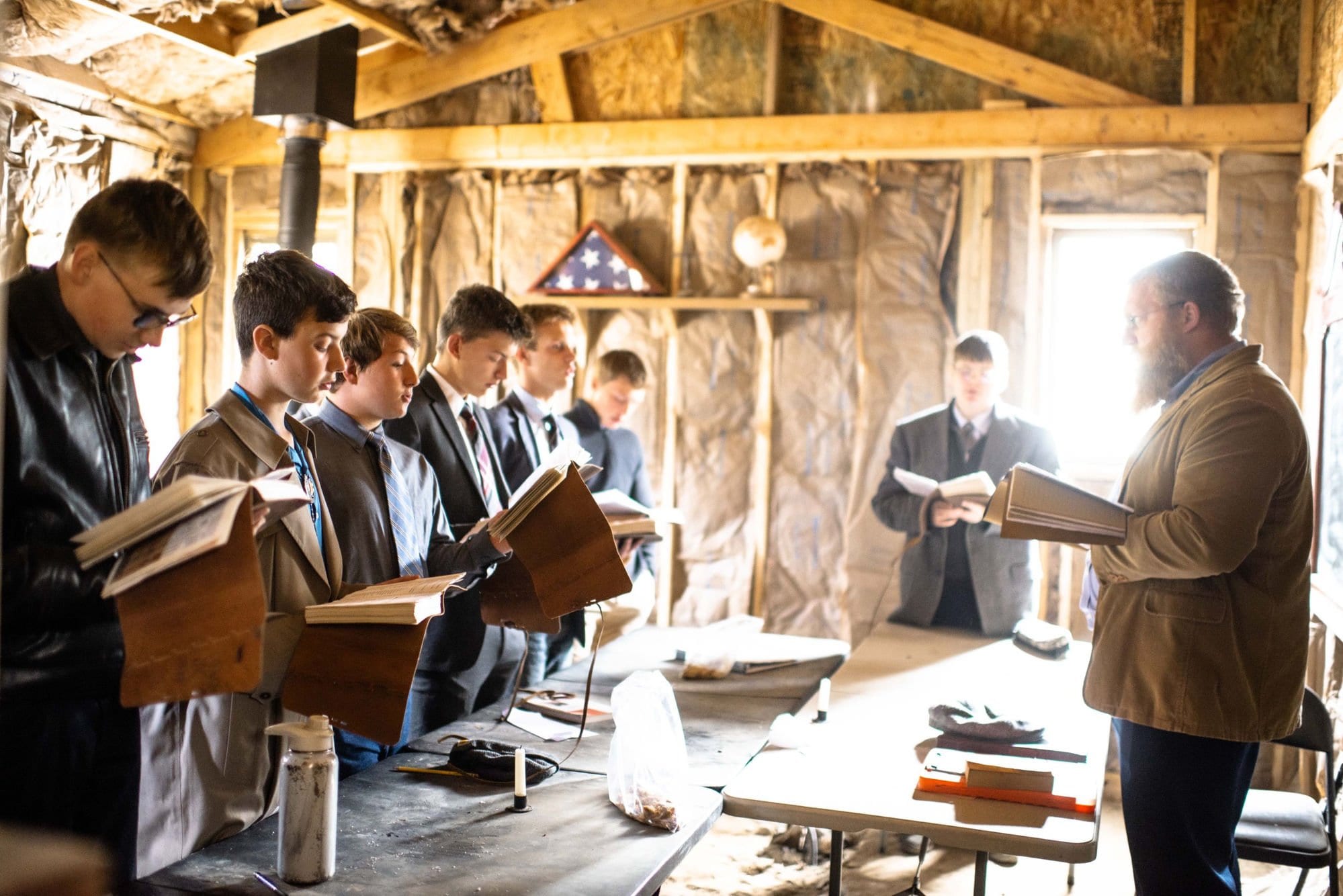
God is the primary teacher of SJWA, and we are “Cooperators of the Truth” helping illuminate the truth to our students. God conveys Himself to us through Creation and Revelation. Man's actions in sub-creation — such as in story, agriculture, or carpentry — help him mediate his contact with the creation and reality into which he is placed, turning wilderness into a farm field, wood into a home, and the gathered sense of human life through struggle, triumph, and tragedy into the consolations of music and story.
Our education intends to form boys gymnastically and musically, as per the ancient Greek tradition of paideia. We call this method Gymnopoetic. Gymnastic comes from the Greek word γυμνός, meaning bare, naked, or unmediated; and poetic from ποίησις, which is a kind of crafting or making.
Our education is Gymnastic insofar as it intends to facilitate real contact between our students and creation, revelation, and the best of man's sub-creative efforts. It is Poetic in its emphasis on craft, whether in the making of music, the writing of poetry, or in the practical arts such as carpentry.
Our Curriculum
Eight tracks, woven together across four years. Hover a track and follow Learn More for its artwork, guiding quote, modus operandi, and full course sequence.
 TheologySacred Scripture, the catechism, and the science of God.Learn More →
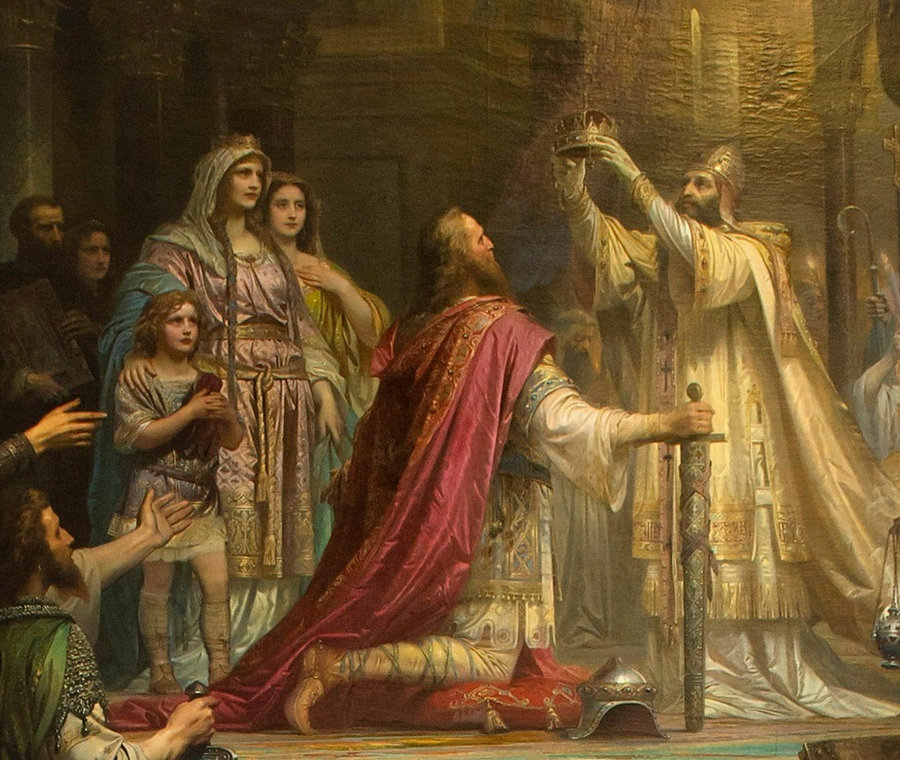 HistoryThe praise of great men and the Providence of God in time.Learn More →
 LiteratureClimbing the staircase of the Western canon, from fairy tale to epic.Learn More →
 ScienceFrom wonder to natural philosophy by the phenomenological method.Learn More →
 MathematicsThinking God's thoughts after Him through pattern and proof.Learn More →
_-_Juan_Carre%C3%B1o_de_Miranda.jpg) LatinThe living language of the West and of the Roman Church.Learn More →
LatinThe living language of the West and of the Roman Church.Learn More →
 Fine ArtsChant, verse, dance, and the great works of our tradition.Learn More →
 TradesGymnastic contact with reality — real work, with real men.Learn More →
Dr. John Senior & St. John Bosco
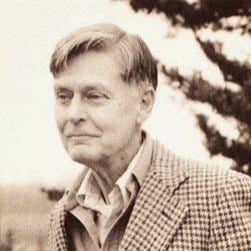
Apostle of realism and Christian culture, and teacher of the Pearson Integrated Humanities Program.
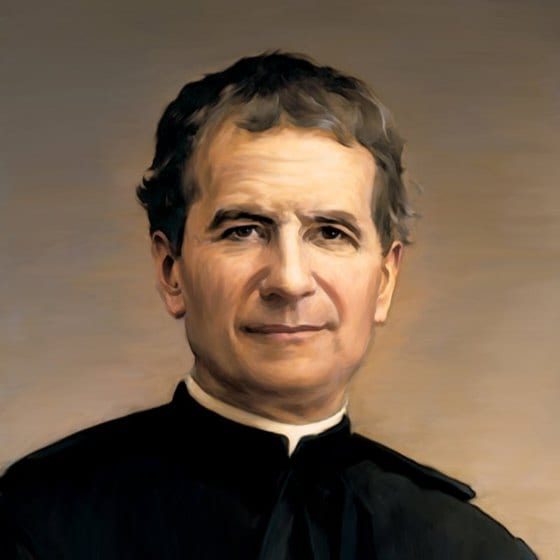
Founder of the Salesians and holy educator of the young — “Da mihi animas.”
Read Dr. John Senior's Life ›
Born in Connecticut, John Senior grew up in New York in a nominally Protestant family. Seeking a more fulfilling way of life than that offered by the city during the Great Depression, at thirteen years old, Senior secured for himself a one-way bus ride to the Dakotas where he learned to work on a ranch. The experiences he had out West instilled a love of the natural world and the cowboy who roamed through it.
After serving in the army during WWII as an interrogator, he studied both literature and philosophy at Columbia University under such renowned teachers as Mark Van Doren, Lionel Trilling, and Gilbert Highet. In 1955, he passed his comprehensive doctoral exams summa cum laude, and obtained his Ph.D. in Comparative Literature in 1957.
Senior dabbled in a great many isms that were prominent in modern academic circles before his entry into the Catholic Church in 1960: Marxism, Positivism, Occultism, and Hinduism. Yet, through his study of Plato, Aristotle, St. Thomas Aquinas, and St. John Henry Newman, Senior was eventually convinced of the veracity of the Perennial Philosophy and of Catholicism.
In the decades after his conversion, he worked tirelessly as an apostle for realism and the faith as society's confidence in the foundations of Western civilization waned. Most notably, he taught alongside Dr. Dennis Quinn and Dr. Frank Nelick at the University of Kansas in the famous Pearson Integrated Humanities Program, which produced numerous conversions and vocations (e.g., Bishop James Conley of the Diocese of Lincoln, Abbot Anderson and Prior Bethel of Clear Creek Abbey, and Archbishop Paul Coakley of the Archdiocese of Oklahoma City and, as of 2026, the current head of the United States Conference of Catholic Bishops). His influential work was not just limited to those he taught in the classroom, however; The Death of Christian Culture and The Restoration of Christian Culture have been inspiring Catholic educators for almost half a century.
Read on St. John Bosco — from Pope Francis' Letter to the Salesians ›
From Pope Francis' Letter to the Salesians in Celebration of the Bicentennial of Don Bosco's Birth:
The memory of St. John Bosco is alive in the Church. He is remembered as the founder of the Salesian Congregation, the Daughters of Mary Help of Christians, the Association of the Salesian Cooperators, and the Association of Mary Help of Christians, and as the father of the present-day Salesian Family. He is likewise remembered in the Church as a holy educator and pastor of the young who opened the way of holiness for young people, offered a method of education that is at the same time a spirituality, and received from the Holy Spirit a charism for modern times.
Italy, Europe, and the world have changed considerably in these two centuries, but the soul of the young has not: even today boys and girls are open to life and to the encounter with God and with others, but there are so many of them exposed to discouragement, spiritual anemia, and marginalization.
Don Bosco teaches us first of all to not stand idly by, but to put ourselves in the vanguard by offering young people an integral educational experience which, firmly based on the religious dimension, affects the mind, the emotions, and the whole person, always considered as someone created and loved by God. This leads to a genuinely human and Christian pedagogy, one that is animated by a concern for prevention and inclusion, especially of the children of the working classes and the marginalized groups of society, and offers them an opportunity for education and learning a trade in order to become good Christians and honest citizens.
By working for the moral, civil, and cultural education of youth, Don Bosco worked for the good of people and civil society, following his particular view of man that combines happiness, study, and prayer, or to put it another way, work, religion, and virtue. This wide-ranging and demanding educational vision which Don Bosco condensed in his motto, “Da mihi animas,” accomplished what we today express in the phrase, “educate by evangelizing and evangelize by educating.”
Pope Francis, Letter for the Bicentennial of Don Bosco's BirthNo Homework
Only on very rare occasions does SJWA assign students homework. The academy has consciously made this commitment for several reasons:
Environment
Students oftentimes do not complete their homework in as conducive an environment as that which the academy creates. Both unavoidable and self-imposed distractions abound outside the classroom, and they handicap students' appreciation for the good that comes from the work.
The Age of AI
With the advent of generative AI software, the academy wishes to make sure the written work its faculty receive from students is entirely their own. Generative AI is often a slippery slope, with students wondering how much Grammarly can rewrite their sentences before it is no longer their own.
Instant Feedback
Completing work in class that otherwise would be done at home gives the students opportunities for instant feedback from the faculty, and for the faculty to better understand where the students are struggling.
A Rightly Ordered Life
Regular homework assignments foster dangerous expectations and habits to which modern man consistently falls prey. The workaday world increasingly encroaches on man's life at home, and this injustice contributes to the phenomenon of absent fathers the academy wishes to help remedy with its formation. The regular order of a man's daily life should involve going to work, working hard, and then coming home to be fully present to his family — and this pattern can and should be imitated with school work.
The Recovery of Leisure
When readings are not assigned as homework, our experience shows boys actually begin to live a life of leisure, often in the company of their family and friends. Many high schoolers only read the work they have been assigned and do not think they have time for “real” leisure reading. By leaving this space open and encouraging them to freely choose the good their faculty also aim at in their personal lives, the boys begin to cultivate studiositas.
A Communal Encounter
When reading takes place in the classroom instead of at home, the students have a more powerful encounter with the literature. There is a vast difference between a student reading Beowulf alone at home and communally listening to a thunderous recitation.
Academics FAQ
How rigorous is SJWA? (Standardized test results, college prep) ›
Even though we have a special focus on the trades, our academy is not a trade school for students who find traditional education too demanding. Our academic program is very demanding, and we focus on forming the mind quickly and efficiently. Also, due to our no-homework model, students must learn to be attentive and mentally agile, as cramming for a test is not an option. Students who are willing to work with good spirit and diligence will succeed. The challenges of our curriculum are met in the spirit of friendship, whereby teachers observe and willingly work with the strengths and weaknesses of the young men in their care, and the students likewise, in charity and respect for their teachers, are moved to cooperate in learning.
What if I want my son to go to college for a technical degree? ›
The gymnopoetic education we have at SJWA will prove extremely useful for a student's further education at the collegiate level. Some supplementation is needed for particular fields, which can be achieved through the partnership with Homeschool Connections. For example, if your son wants to go into Engineering at UM he would fulfill the required credit load, but would need Trigonometry, Pre-Calculus, and ideally Calculus for a competitive application. This does increase the required workload, but any student considering such a path will do well being comfortable with longer academic hours than their peers.
How do boys write papers with no homework? ›
The great problem with a boy's writing is his ability to produce words. You can give a boy a rich prompt; he will eke out a paragraph and think no more can be written. We want our boys to write easily, beautifully, and coherently. To achieve this our writing program focuses on three things.
First, we have many small writing assignments. For example, in history class they write for 10 minutes at the end of every class to increase their ability to let words flow from their pen. Constant writing is the best way to get past that hurdle.
Second, all of the boys learn how to write in verse Freshman year, and the writing of verse continues almost every day throughout all four years. Small verse assignments focus the students into listening to the sound of every syllable in a sentence to write in a beautiful way.
Finally, we have them write many longform papers. At least five times a semester they will focus on multi-page papers, written by hand and using physical books from the Academy's library for research. Without the technological crutch most boys grow up using, their paper-writing abilities greatly increase.
How does the Academy handle grades? ›
SJWA strongly believes a letter grade is the least important part of the feedback a teacher gives to his student after an assignment; in our years of experience, we have found that letter grades tend to oversimplify the estimation of a student's performance, and the more helpful and nuanced thought of the professor expressed in other ways gets lost behind fears involving post-high-school aspirations. That said, we realize that our academy will need to often interact with colleges who use such marks for a variety of reasons. Given all of the above, we grade on a standard 4.0, A–F grade scale, though for students that surpass the expectations associated with an “A,” we have an Honors grade represented by an “H.” Letter grades are primarily shared with parents via a program called Regula. Students will usually receive only verbal feedback on what went well, what did not, and how they can improve.
What if my boy is not interested in being a tradesman? ›
We are not teaching trades so the boys can all become tradesmen. Both John Senior and St. John Bosco saw the importance of physical activity for the development of boys. Many different physical activities build up a person's work ethic; to go and dig something as simple as a post hole, he has to root out expectations of immediate gratification and instead cultivate perseverance. When it feels like one is only pulling teaspoons of dirt out at a time, he needs to push forward and keep going to reach the desired end state. The trades are among the best physical activities for developing boys' work ethics, as they develop real scope and competency while making beautiful (rather than merely utilitarian) products. The look on boys' faces when we did our recent barn-raising events, for example, is incredible; they realize they too are able to do meaningful work like actual men. This confidence bleeds into the classroom, and the boys are more willing to make mistakes, ask precise questions, and really learn when surrounded with others who share those profound experiences.
Are the teachers certified in the State of Michigan, and is the academy accredited? ›
While we collectively possess decades of teaching experience between us, the faculty at St. Joseph the Worker Academy are not certified by the State of Michigan, and our intention (at least for the near future) is not to pursue accreditation for the school itself. Of course, we will abide by all local, state, and federal laws and will meet the basic expectations for high school students and graduates, but we believe that accreditation processes sometimes inhibit schools like ours from focusing on what students really need to eventually take up their responsibilities in a free society.
What is the end goal of this type of high school education? ›
Among many other goals, we want to address the growing need for remedial education by effectively accomplishing that which is allotted to this stage of formation in a boy's life. Increasingly, we see Ivy League schools offering courses that are beneath what should be learned at college because people are ill-prepared for the traditional classes. We hope to prepare boys well for the tasks proper to each good track they can take in life after graduation, whether it is collegiate education, seminary or monastic formation, uniformed service in the military or law enforcement, or fine arts work in the trades. We also hope that their immediately apparent, competent leadership in any of those areas inspires people to trust, once again, that young people are more adept at learning than we have recently given them credit for.
Partnership with Homeschool Connections
For students who want to broaden their horizons with classes we do not offer, SJWA has a partnership with Homeschool Connections, a Catholic online education service with a catalog of 750+ courses. These include things like pre-calculus, Chaucer, law, microbiology, Greek, photography, culinary arts, and more. Students can take these classes through SJWA and have our faculty do the grading of assignments.
Browse the Recorded Course Catalog →

Theology
Theology is a science. To study any science, one must know the principles of the science, and one must have strong encounters with the subject matter of the science. Before one can do theology, one must study the catechism — the basic principles of theology — and the Sacred Scriptures, which, along with Sacred Tradition, provide the subject matter.
Our Theology track starts with a catechetical semester, and then focuses on a deep dive into the Scriptures, looking at how the Fathers read Scripture, and reading Scripture in the light of the Church. In the last year and a half, we move beyond the Scriptures, focusing on the spiritual writings of the saints, and then move to a practice of theology as a science, looking to the Church Fathers and doctors and their enemies to see how theology can be done well or poorly.
Course Sequence
CatechesisFreshman Year · Fall Semester ›
Students will read the Baltimore Catechism, cover to cover. The teacher will make frequent use of the current, universal Catechism of the Church to develop the shorter answers the Baltimore Catechism gives to questions. While not the primary focus of the course, the teacher will occasionally challenge certain assertions of the Catechism and ask students to use the “tools” previously acquired in the Catechism to answer the objections or resolve the difficulties given by the teacher. This aspect of the course will be students' brief introduction to apologetics.
Scripture: Old Testament HistoryFreshman Year · Spring Semester ›
Students will begin reading the story of Salvation History, and the teacher will help the students see the story of Scripture through the eyes of God's faithful at the time in which that aspect of the story was given. While the course will focus on the Pentateuch and the subsequent historical Old Testament books, selections from the major and minor prophets will also be read. Certain persons, sacred edifices and objects, etc. will be noted as being of recurring importance.
Scripture: New Testament SynopticsSophomore Year · Fall Semester ›
Having completed the Old Testament, students will discover the significance of the Incarnation, the Ministry, the Death, and Resurrection of the God-man, Jesus Christ, through the Synoptic Gospels, the Book of Acts, and the Pauline Epistles. Recurring themes will be highlighted so that students will better understand the salvific message Christ gives to the disciples, not just in antiquity, but also today.
Scripture: ProphetsSophomore Year · Spring Semester ›
In the Prophets semester we return to the Old Testament where we encounter the major and minor Prophets, as well as the books of Tobit, Judith, and Esther. The Prophets prompt us to consider the Covenant and how we are living it as a community and as individuals. The Prophets illuminate the life and ministry of Christ while also aiding us in gaining a deeper understanding of right relationship with ourselves, others, and God.
Scripture: WisdomJunior Year · Fall Semester ›
In the Wisdom semester we prayerfully study the Psalms and Wisdom Literature of the Old Testament, the Catholic Epistles, John's Gospel and Letters, and the Book of Revelation. Here we will be diving into the deepest parts of scripture, planning to read and appreciate these texts as guides for right living, for prayer, and for Christological reflection. A special focus will be on the Church Fathers' interpretation of these works, providing students with paradigms and resources by which they can faithfully and accurately interpret these writings and other biblical texts.
The Devout LifeJunior Year · Spring Semester ›
In this part of the Theology track, students move beyond the Scriptures, focusing on the lives and spiritual writings of the saints and doctors of the church. There is a great depth to the spiritual life, and through these works the boys can reflect on that depth. Special attention will be paid to the writings of St. Francis de Sales, St. Benedict, and the Carmelite mystics (e.g. St. Teresa of Avila, St. John of the Cross, etc.).
TheologySenior Year · Full Year ›
There is a great difficulty in “doing” Theology instead of merely reading Theology. The Science of Theology is a difficult one but essential to understand so we do not get trapped into confusing theological inquiry with catechetical truth. In this course the boys learn how Theology is done (and not done) by considering various Theological issues through the writings of various theologians from Church Fathers to ancient heretics. By the end of the course they will understand the legitimate diversity of thought that exists in the doctors of the church and understand how one should approach a Theological question.
Modus Operandi
In Theology, the primary focus is upon the text. We spend the majority of our time reading the scriptures, catechism, or other texts, pausing for discussion, further context, and apologetic and moral insights. Theology also has a strong writing component, writing essays on the apologetics thread that always exists in Theology, and encomiums on the various parts of scripture.
In addition to our Theology classes, we have optional scripture reading for 20 minutes before every school day starts. If a student attends all of these he will go through the entirety of the scriptures every two years.
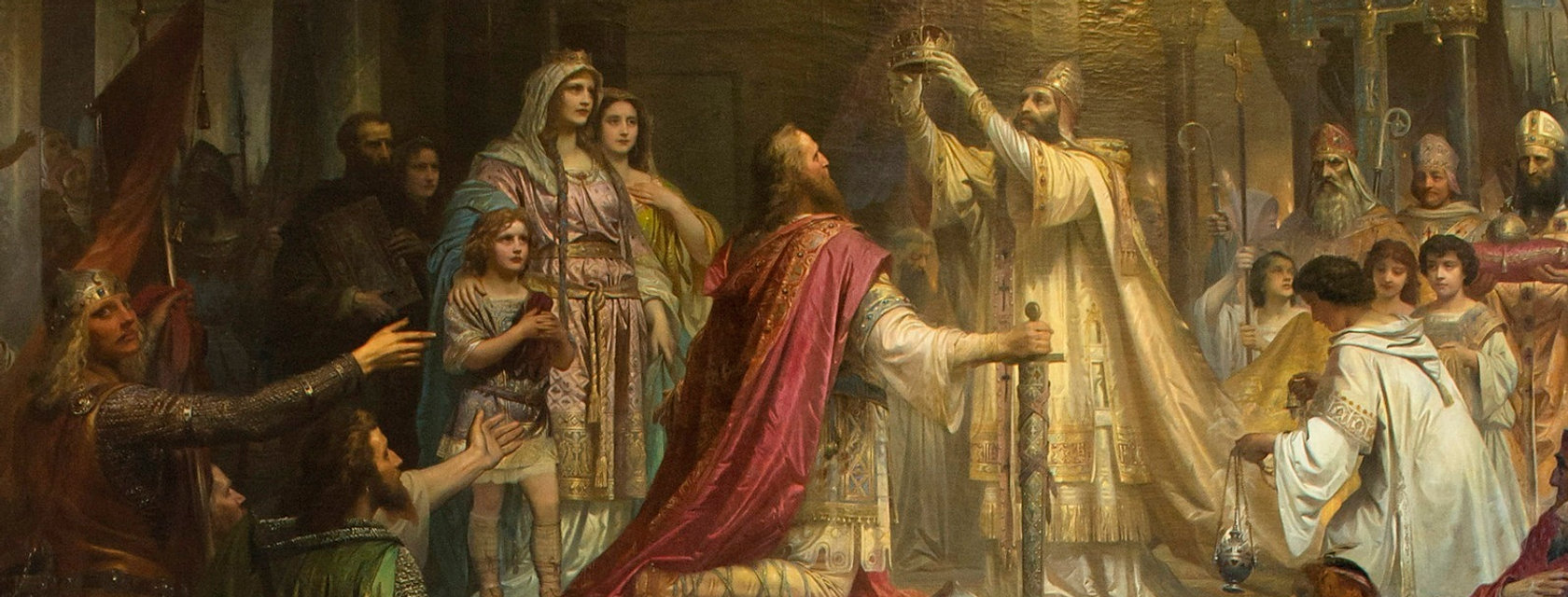
History
History, as Herodotus says, is the praise of great men of the past. To understand history is to know the stories of these great men, to see the patterns in their stories, and to better understand human nature.
This course will chart our history, especially focusing on Western Civilization and God's Providence working in history. Initially showing how God led civilization up to the fullness of time, when the Divine Word became Man and founded his church, the Holy Catholic Church. From that point, we follow the wild ride of the bark of Peter, through heresies, persecutions, periods of great corruption, and times of great flowering, all the way up to the Modern Day.
Course Sequence
Ancient YearFreshman Year · Full Year ›
The Ancient Year in History spans from the creation of the world to the political victory of Christianity with the Edict of Milan. The true developments of pagan antiquity will be examined, as well as the shortcomings of the ancients, all in preparation for the Incarnation of the Son of God. This course will include notable stories including Akhenaten's Egyptian Monotheism, the Bronze Age Collapse, Tiglath-Pileser III's conquests, the Persian and Peloponnesian Wars, the Punic Wars, the Incarnation, and the saints of the Early Church.
Medieval YearSophomore Year · Full Year ›
This study of the medieval world will especially manifest the depths of culture and community under the direction of the Gospel, displaying how the Church “took gold from Egypt,” absorbing and Christianizing truth, goodness, and beauty from Roman, Greek, and Germanic traditions. It advanced the cause of human dignity, curbed warfare, elevated women, protected the weak, and abolished slavery for the first time in human history. Students will develop in themselves something of this great “medieval synthesis” as well as something of the patience of the Church that knows that lasting and meaningful change is only achieved slowly.
Modern YearJunior Year · Full Year ›
The destruction of Christendom came from three main events: the Protestant Revolution, the Enlightenment, and the Industrial Revolution. Rejecting the unity of faith and reason, church and state, man and work, these events created profound imbalances in Western society. In this course we go through these events, and how men tried to fill these vacuums in many unsuccessful ways, causing great destruction to Europe. In response to these calamities, great men have risen up time and time again to hold onto the good and oppose its destruction.
Politics SemesterSenior Year · Fall Semester ›
Students will first be led through a brief survey of Western Political thought to understand the basics of Political Philosophy in the Western Tradition. This begins with the pagans Plato and Aristotle, moves into our Christian tradition with considerations of writings of the early Church Fathers and the wisdom of Saints Augustine and Thomas, and finally leads to the brilliant yet destructive developments of Enlightenment thought leading up to the American Revolution.
American Government SemesterSenior Year · Spring Semester ›
Having established students in the strong grounding of the Western tradition, the course will then consider our American founding and government, reading through the Declaration of Independence, excerpts of the Federalist Papers, the Constitution and Bill of Rights, the reflections of Alexis de Tocqueville in his Democracy in America, and selections from Presidents and other great political figures throughout American history.
Modus Operandi
History is focused on the telling and discussing of the stories of the past. Instead of reading long textbooks, the students will listen to stories from the teacher and read some primary texts. Besides listening and reading, they will be discussing the stories, adding events to their timeline, and memorizing core dates.
The timeline is especially important; each boy makes a 56-foot-long history scroll, where each inch is 5 years. During the four years at the academy students add to this single scroll. The long scroll helps illustrate to the students the connections between different stories and the unity of history.
During the last ten minutes of each class they will take out their history notebook to summarize the events of class or elaborate on a favorite scene, over the years forming a great tome of history. History's daily writing forms a key pillar of our cross-curricular writing program.

Literature
Our literature program is coordinated with an eye to giving students works — books and poetry — that they can read well: those stories that are of the highest accessible quality, one step above where students are, to lead them up a staircase towards the best literature without ever giving them things too difficult to digest. Pulling from our Western Literary tradition, and especially with regard for the recommendations of John Senior, the students will spend the first three years on “the good books,” starting with fairy tales and ending with Dickens. The program will culminate with reading some of the most foundational and influential books of the western tradition: Homer's Epics, Dante's Commedia, and Shakespeare's Plays.
Course Sequence
Fairy & MythFreshman Year · Fall Semester ›
This course covers the fundamentals of literature, what Dr. John Senior would say everyone should first read when they are young and then re-read throughout the rest of their lives: Fairy Tales from Lang's Collections, Fables from Aesop, Nursery Rhymes such as those of Mother Goose, and tales from 1001 Arabian Nights. These works will focus on shaping the interior senses of imagination and memory which are indispensable for later courses in which students will encounter greater works (i.e. books with scope). The attributes and roles of various gods and goddesses and mythical creatures, along with several Mother Goose nursery rhymes and poems, will be committed to memory.
AdventureFreshman Year · Spring Semester ›
This course will cover works such as Tolkien's Hobbit, Stevenson's Treasure Island, and Pyle's King Arthur, paying special attention to the conspicuous growth protagonists undergo throughout the course of their perilous journeys. Students, who are themselves on the great and dangerous adventure of life, will draw vitally important inspiration from the fortitude, the quick-thinking, and even the responsiveness to divine or otherwise benevolent promptings of the various characters.
GrimSophomore Year · Fall Semester ›
Having ventured boldly into the wide world in the last semester, students in this course will consider the effects of original sin in the human experience. Reading through Norse myths and Anglo-Saxon poetry gives a grounding experience of the transient nature of the fallen world and of man's life in it. Gothic literature, including poetry and short stories from Hawthorne, Poe, and Coleridge, as well as Marlowe's Doctor Faustus and Robert Louis Stevenson's Jekyll and Hyde, will demonstrate the reality of moral evil and how it contributes to the corruption and collapse of human life and culture. This will serve to balance the enthusiasm of the previous semester, all the while it anticipates the following semester's focus on heroism as response to evil.
HeroicSophomore Year · Spring Semester ›
If the previous semester emphasized the fallenness of our world and the reality of evil, this semester considers the reaction one should have towards the evil of the world. Works such as Mark Twain's Tom Sawyer and Joan of Arc, the Anabasis, the Song of Roland, and the Lay of Beowulf will remind students that God often chooses to defend the often frail light and warmth of human civilization by the strong backs, bold hearts, and quick wits of heroes. Special emphasis will be placed on the Lives of the Martyrs as we pass their feasts in the year, and the comparison of the respective heroics of the martyrs and the heroes of our stories will provide material for the semester's writing assignments.
RomanceJunior Year · Fall Semester ›
The heroism considered in the previous semester is now observed as it becomes an entire way of life guided and enriched by the Faith: Chivalry. Chivalry will be the central focus of this course, and students will read both earnest and light-hearted works which concern themselves with Christendom's code. The course's exploration of heroic characters will note that they are more noble than many of the individuals from earlier stories but that they are also not quite the demigods which will be essential to the epics soon to be studied in senior year. In a word, the magnanimity of these dutiful, mortal men will help students capture the essence of the knight and his ways.
Via ContemplativaJunior Year · Spring Semester ›
The literary focus this semester is the interior life of man, pairing well with the “Devout Life” course in the Theology track. Jane Austen, Dostoevsky, Ovid, Dickens, and others will be the students' guides as they travel through the depths of the soul.
The Cosmic OrderSenior Year · Full Year ›
This course concerns itself with the great epics of the canon of Western Literature, with works like the Iliad, Odyssey, the Divine Comedy, and Shakespeare's plays enjoying pride of place. Themes from all previous courses will be woven together both by the teacher and by the authors who perfectly understand the gravity and place of the created world's facets.
Modus Operandi
In Literature, the majority of each class is spent either in instruction, reading (aloud or silent), discussion, or assessment, and the last five minutes in drawing or writing short verse.
The instruction portion of the class is intended to be the smallest portion, and will focus on important contextual details or paradigms for stories. The teacher will use his instruction time to prepare the boys for the stories they will walk through in order that the encounters along the way might be more fruitful.
Throughout the readings, analysis of the text will be conducted in class discussions, where the boys will struggle together under the guidance of the teacher to grapple with the story.
Due to our no-homework policy, readings must be completed in class, and so a significant portion of the course consists in traveling through the texts together, encountering the stories' highs and lows as comrades, strengthening fraternal bonds through common vicarious experience. Most of this reading will be out loud, so the students can develop their abilities as story-tellers and expand their attention spans in regards to enduring and comprehending human speech.

Science
Wonder is the root of the natural sciences. When one has wonder at nature, it begets a desire for Natural History, in which the experiences marveled at are gathered and provisionally organized. From there the mind moves to Natural Science in which theoretical frameworks and hypotheses are created to understand the information held. This culminates in Natural Philosophy in which we learn the causes of material things. In each year of the science track, the students go from wonder to Natural Philosophy, learning about nature in deeper and deeper ways.
Course Sequence
Field ScienceFreshman Year · Full Year ›
Wonder is the root of the natural sciences. This course is an introduction to the natural sciences, putting the students into direct contact with the local natural environment. They will be having immediate experiences with geological formations, fauna, flora, and the heavens. Their perception of the natural world will be sharpened as they learn to notice and understand the distinctions in the natural world around them and learn practical tools of sketchwork. Students will be spending much of the class outdoors, drawing and recording data in their sketchbooks, and memorizing distinctions in the natural world.
BiologySophomore Year · Full Year ›
What distinguishes dead and inorganic matter from the living? How do biological systems utilize energy and molecular building blocks to grow, reproduce, and maintain homeostasis? How are creatures organized and distinguished from each other? These questions and more are the focus of our Biology course. Through phenomenological observations, dissections, and reading source texts, students are expected to develop a solid grasp of biological concepts, theories, and laboratory techniques.
ChemistryJunior Year · Full Year ›
This course intends to introduce students to the intricacies of the atom, properties of material substances, under what conditions substantial change takes place, and the associated effects of such changes. The course places a significant emphasis on real-world examples with many experiments, and an understanding of the historical development of our understanding of the atom. Chemistry problems require an orderly method, attention to detail, and patience; developing these skills is a good in itself, but also builds up a boy's critical thinking faculties in general.
PhysicsSenior Year · Full Year ›
In this Physics course we focus on the fundamentals of physics through real-world examples. This allows students to pick up on the patterns of the natural world, resulting in a strong conceptual understanding. This understanding is primarily a good in its own right but also allows for students to make accurate predictions about the behavior of the physical world. A strong emphasis is placed on developing analytical and problem-solving skills.
Modus Operandi
The word science comes from the Latin scientia, which means knowledge derived from observation; this is why the science track is taught using a phenomenological method. The phenomenological method is based around a rhythm of “Do. Observe. Conclude.” First we do an experiment that displays some important concept, whether that is an observation of types of trees, a dissection of a heart, or manipulating pulleys. After our experiment we focus on our observations: what patterns do we find, what strange properties do we notice, what observations have we seen before but not noticed until now? We end a module by pulling out the answer — the physical constant, the physiology of a muscle, etc. — bringing forth the many observations of scientists before us so that we can understand more deeply the things observed.
Throughout all four years there is a secondary science track, Astronomy. Astronomy is 15% of the science grade each year as students observe the stars and become more familiar with their movements year by year.

Mathematics
Mathematics at its core is a conversation generated by man's search for the methods of God. Early mathematicians looked for symmetry, form, and meaning based on their deep-rooted belief in a logical creator. Our goal is to help students see mathematics in a similar way, as a tool (refined through effort and experience) to solve problems and, in doing so, to reveal the mind of God expressed in the universe around them. Mathematics is innately beautiful in pattern and symmetry, and is best learned when students use math to solve problems they need answers to (relevant) and when exposed to the supernatural beauty of mathematics (aesthetic experience). Mathematics is also a great teacher of logic and reasoning in the service of understanding truth. In our math program, students will workshop problems together, explore topics until understood, and then make annotated algorithms, authoring their own math text as they work through the progression of math content.
Course Sequence
Euclidean GeometryFreshman Year · Full Year ›
Students will complete Book I of the Elements of Euclid as their introduction to one of the four arts of the Quadrivium: Geometry. Students will memorize its definitions, postulates, and common notions, discuss the nature of first principles, and encounter the logic of one of antiquity's greatest mathematicians by demonstrating each of the propositions. Occasionally, students will attempt to develop alternate proofs to see how concise Euclid's proofs are. Careful attention will be given to help the students see the proofs not as a series of more or less complicated assertions temporarily stored in short-term memory but rather as beautiful necessary conclusions to previous demonstrations.
Algebra I & IISophomore Year · Full Year ›
This course integrates the essential skills of Algebra 1 and Algebra 2 through application-based geometry problems that help students understand why algebra works, not just how to perform algorithms. Students will explore linear and quadratic relationships, systems of equations, functions, polynomials, and exponential models, all within the context of real-world geometric situations, including measurement, scaling, surface area, volume, trigonometry, and spatial reasoning. The course leverages our students' logic background from Euclid to teach college algebra as a conceptual framework for problem-solving. By using geometry as the foundation for problem-solving, students develop deeper conceptual understanding, stronger reasoning skills, and the ability to connect multiple areas of mathematics in meaningful and practical ways.
Discrete MathematicsJunior Year · Full Year ›
Discrete Math offers students a fresh perspective on mathematics by focusing on patterns, structures, and decision-making processes that unfold in clear, discrete steps rather than continuous change. This application-driven course highlights the beauty, symmetry, and logical design found throughout mathematics while demonstrating its real-world relevance in business, technology, government, and everyday problem-solving. Students explore engaging questions — such as how barcodes encode information, how to design the most efficient delivery route, how probability affects decisions like buying a lottery ticket, and what it means to divide resources fairly in complex situations. Along the way, they learn key concepts from voting theory, fair division, graph theory, networks, algorithms, counting, probability, coding, and digital systems. By the end of the course, students are equipped with practical tools and mathematical habits of mind that help them understand the structured patterns underlying the modern world.
StatisticsSenior Year · Full Year ›
Students will develop an understanding of scientific methodology and how this methodology has developed to its present form. Most notably, they will consider how the scientific method has come to be shaped by developments in mathematics, corresponding to deduction and induction. Inductive reasoning finds its mathematical expression in probability and statistics. Students learn the essential role of probabilistic reasoning in science, the degree of certainty that can be based on such arguments, and how these arguments are different from but compatible with the reasoning we employ in other disciplines. The successful student will learn to utilize probability and statistics to empirically test hypotheses and weigh scientific evidence; interpret data from scientific experiments; design simple scientific experiments; identify the characteristics of legitimate scientific reasoning that distinguish it from pseudoscience; and understand the historical roots of the modern scientific method and the philosophical and epistemological basis of scientific reasoning.
Modus Operandi
Mathematics is the purest of academic pursuits and is essentially how we think God's thoughts after Him. When we study mathematics, the boys spend time modeling, describing, puzzling, and solving problems. Most lessons are indirect in nature, as discovery and exploration are the best ways to learn the tools of mathematics. Classes revolve around the design process, from defining the problem to optimizing and verifying a solution, during which we workshop problems by sharing ideas and brainstorming the best methods of solution.
Once that process is complete, the class develops an algorithm, which is then added to their personal textbook throughout their time at StJWA. We teach mathematics in a deeply connected and conceptual way. Connections give mathematics context, and conceptual understanding allows the boys to apply what they have learned to new situations. The beauty and symmetry of mathematics are explicitly taught as a means of seeing the Creator's hand in an ordered and logical universe. This is accomplished through hands-on exploration and mathematical modeling in the classroom.
The logic-intensive and modeling-centered character of our mathematics program provides an ideal preparation for demanding examinations such as the CLT and SAT, equipping students to approach these assessments with the mind of a test-maker rather than merely the posture of a test-taker.
_-_Juan_Carre%C3%B1o_de_Miranda.jpg)
Latin
Latin is the foreign language taught at SJWA because it is the historical language of the culture of the West and the universal language of the Roman Catholic Church. As Saint John XXIII stated, Latin “is a most effective training for the pliant minds of youth. It exercises, matures, and perfects the principal faculties of mind and spirit. It sharpens the wits and gives keenness of judgment. It helps the young mind to grasp things accurately and develop a true sense of values.”
Many schools teach Latin as a codex, something for translating ancient texts. We will be teaching Latin as a language, so that the students can interact and communicate with each other. This “Nature Method,” developed by the Danish educator Hans H. Ørberg, allows the students to learn in a natural way. Through observation and noticing context, the students grow in an understanding of Latin and sharpen their faculties of observation and reasoning.
Course Sequence
Latin IFreshman Year · Full Year ›
The first two semesters aim to give students familiarity and proficiency with simple Latin. Students will be able to read simple Latin texts independently and make useful conversation comfortably. The course will work through the first third of Ørberg's Familia Romana and make use of Ørberg's other materials (especially Colloquia Latina and Fabellae Latinae).
Latin IISophomore Year · Full Year ›
The second two semesters aim to lead students into intermediate Latin. Students will continue to work through Ørberg's works and have a special focus on primary texts (especially the Vulgate and the Roman Missal). Readings of the Vulgate will be planned to correspond with readings in the Scripture course.
Latin IIIJunior Year · Full Year ›
The third two semesters aim to bring students through the upper levels of intermediate Latin into more advanced Latin. Students will be able to engage with more difficult Latin texts, working through more primary materials and making more complex conversation. In the Junior year, other classes — including History, Arts, Literature, and Scripture — will have specified “Latin class days” where all or some of those class periods will be conducted in Latin. This course will work through the rest of Ørberg's Familia Romana, Colloquia Latina, and Fabellae Latinae, in addition to continuing studies of the Roman Missal and the Vulgate.
Latin IVSenior Year · Full Year ›
During senior year students will read more advanced texts from both Classical and Medieval authors and begin to converse fluently in Latin. This course will work through Ørberg's Roma Aeterna, the connected Fabulae Syrae, and selections from primary texts such as the Aeneid, Caesar's Gallic Wars, and Livy's Ab Urbe Condita (which will reiterate stories covered in Freshman history).
Modus Operandi
In classes there is minimal English spoken, to provide an immersive situation for the language. Phrases will be used, and brought into the other classes and the rest of the school day. Students will have Ørberg's Latin guide to help them move forward along this path.

Fine Arts
The Ancient Greek Tradition of education, which has become the foundation of so much, held that the initial formation was the “paideia”: primarily musical and gymnastic. Our whole education is coordinated to form students in these two directions. The trades component in particular offers a valuable experience of the servile arts, which are necessary and noble; and yet our goal is to form the whole human person towards Christ in a balanced way. This means that the fine arts must also have their place. We want to avoid “the weak-chested intellectual,” but also to balance the rough and arduous dignity of manual labor with the refining influence of the fine arts.
And so not only will our boys study carpentry and masonry, but also architecture and art. Not only will they exert themselves digging, moving heavy stones, and using their body in ways productive and empowering, but they will also learn to use their bodies in dance, honing their masculine strength and native swiftness under the guidance of music, in right relation to the feminine. The Arts course starts with music and ends with music. It begins with Gregorian chant, then moves to the reading and writing of verse, followed by a course in dance and then architecture. Junior year they take up calligraphy, refining their handwriting, and then iconography. Senior year has a rigorous course of art and musical history, showing them the greatest works of our tradition.
Course Sequence
ChantFreshman Year · Fall Semester ›
For centuries, the Church has proposed and warmly recommended Gregorian chant as a formator of souls, a liturgical norm, and even a method of prayer, yet the most frequent experience today is that chant is secondary to other forms of music or even an afterthought. This initial course in the arts sequence confronts this problem by presuming that, much like a backpacking journey in the mountains can awaken a latent love of nature, so a loving immersion in Gregorian chant can stir up students' hearts not merely to be competent in but even to gain a degree of love for chant as a way of uniting music and worship handed down to us by so many fathers in faith. Accordingly, students will sing simple and intermediate Gregorian compositions as well as grow in understanding of the theory and spirituality of Gregorian chant, including through composing their own melodies.
VerseFreshman Year · Spring Semester ›
This course intends to open a door into the world of poetry. By writing and reading massive amounts of simple and enjoyable verse, students will gain the experience necessary to (1) write in verse with facility; (2) understand the technical elements of poetry and recognize them at work on the page; and (3) turn to reading and writing poetry for enjoyment and expression. Students will also, incidentally, become well acquainted with many of our great English poets, at least in their most accessible moments.
DanceSophomore Year · Fall Semester ›
Students will learn the basics of several traditional dances, whether partner-oriented or group-oriented (e.g. the waltz, contra dancing, etc.). In learning the basics, students will find their posture and movements both in and out of the class become more intentional, coordinated, and graceful. For this course we will be inviting female siblings and friends to join the boys in learning how to dance.
ArchitectureSophomore Year · Spring Semester ›
Students will contemplate the buildings of different historical periods and geographic locations in the West as well as the vision of the architects who built them. The teacher will emphasize the tradition that gradually develops and that can, in the best examples, be built on even in our own day. Sacred edifices, even those of pagan antiquity, will be given pride of place over the most beautiful of their secular counterparts. As often as possible, students will view buildings without any technological medium during trips, but, in most cases, the teacher will have recourse to media (e.g. pictures in books) to represent the buildings. The course will not just consider the emotional impact of the works, but will also deal with mathematical concepts (e.g. proportion). During this course students will learn how to create some simple architectural designs and draw with proper proportion and perspective.
CalligraphyJunior Year · Fall Semester ›
In an age in which most people's handwriting has become illegible, students will learn writing techniques (beginning with cursive) to ensure their words can not just be read but also be edifying in their appearance. In learning to write beautifully, students will find themselves considering their words more carefully in terms of their meaning, their order, and their memorability.
IconographyJunior Year · Spring Semester ›
As all sacred art is iconographic in nature, students will study various windows into heaven and learn their characteristics well. How are they similar to or different from merely veristic artwork? How do holy individuals or events differ from wicked or mundane ones? Why does the early Church feel the need to defend icons so vigorously? These and other questions will be entertained, all while students learn to implement the visual art techniques they have learned in other classes to create their own icons.
Art History & DrawingSenior Year · Fall Semester ›
This course provides a historical survey of select periods of art and training in the technical elements of drawing. Moving beyond the focus on iconography, the historical narrative of art continues through a study of the great works of Western painting, with lectures and seminar discussions devoted to the themes of the naturalism, humanism, and realism of the Renaissance and Baroque period, and to the dissolution of these realist forms in the 19th and 20th centuries. Lessons on art history are punctuated with lessons on composition, artistic ratios, spatial zones, and other techniques as students view examples of them in the artistic tradition.
Music and the SoulSenior Year · Spring Semester ›
In our day, souls are inundated with music in a manner unprecedented in history. While most people have an intuition that some of this music is better and other music worse, issues arise in clarifying legitimate preferences versus objective worth. This course presumes that, much like understanding a forest ecosystem begins with taking stock of the varieties of life inhabiting the area, so making sense of modern man's musical experience ought to be founded upon taking stock of the music man has made through millennia and striving to see what man's music-making tells us both about man and about music. Accordingly, students will listen to musical works from ancient times through the modern day and consider them deeply through the lens that, just as the books we read and write or the structures we build and inhabit both reveal aspects of man and form man, so music teaches us about God's design of our souls and forms us to fulfill His plans.
The Play Cycle
During the four years at SJWA students will put on four plays.
Freshman year has the boys perform the medieval play Everyman during Lent. Everyman is an allegorical account of the life of Everyman, who represents all mankind. Death comes to take him on a journey, and Everyman goes to his other friends (Kindred, Goods, Beauty, Strength, etc.) to see if any will accompany him.
The Sophomores perform the first play of the year, the Second Shepherds' Play. This is another medieval morality play, wherein a group of shepherds must rescue one of their sheep, which has been hidden in a cradle indoors by a comically evil sheep-stealing couple.
The Juniors and Seniors work together on an annual end-of-the-year Shakespeare performance. This is a public ticketed event, unlike the first two plays.

Trades
The academy's goal for the trades program is not that each of the boys becomes a tradesman. Rather, SJWA wants students to gain a gymnastic contact with reality, a stronger work ethic, a genuine rite of passage, and real competency — the fruits described in the courses at right.
What the Boys Gain
Gymnastic Contact with Reality ›
A gymnastic contact with reality, in which the boys press and push against real (as opposed to virtual) things and allow the natural world to speak to them. This is why carpentry is at the core of our trades program.
A Stronger Work Ethic ›
By persevering through adversity to see a beautiful project through to completion, boys will learn a skill that will reverberate elsewhere in their lives.
A Rite of Passage ›
A “rite of passage” element of doing adult work with adults. When they are apprenticed by workmen in the community, they get to see how their mettle stacks up against reality in a clearer way than any contrived test.
Competency ›
A boy can grow up able to do the “basic” house maintenance that was common 50 years ago. This also gives boys confidence that they can achieve things, which bolsters their confidence in the classroom.
The Bosco Aim
Whether a student becomes a tradesman, goes to college, or enters seminary, the trades program at SJWA will set him well on the right track. Both John Senior and St. John Bosco saw the importance of physical activity for the development of boys, and the trades are among the best physical activities for developing a boy's work ethic while making beautiful (rather than merely utilitarian) products.